
75 Years of Discovery
Celebrating 75 years of research, education, and life-saving breakthroughs at UCLA’s medical school.
Humble Beginnings. A Lifetime of Impact
Learn About Our Mission
The Birthplace of Life-Saving Discoveries
1st Ever
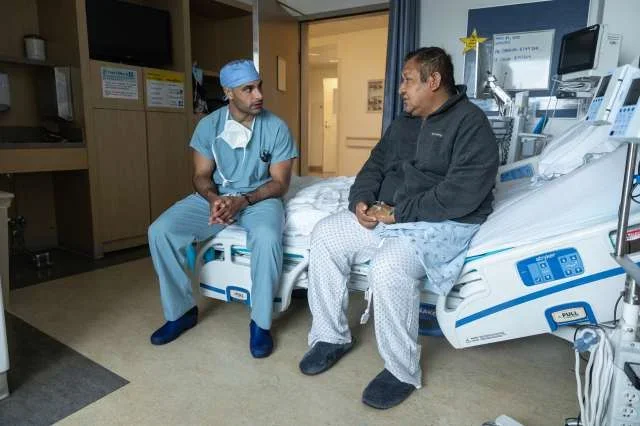
A historic surgery, the result of years of research, opens the door for improved treatments.
300K+
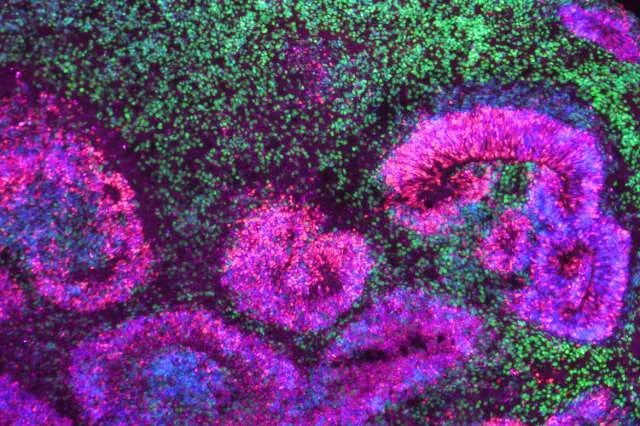
Genomic data is essential to innovations in human health.
Nearly 3M
UCLA Health's cancer researchers are at the forefront - and have been for over two decades.
Breakthroughs Like These Don’t Happen by Chance
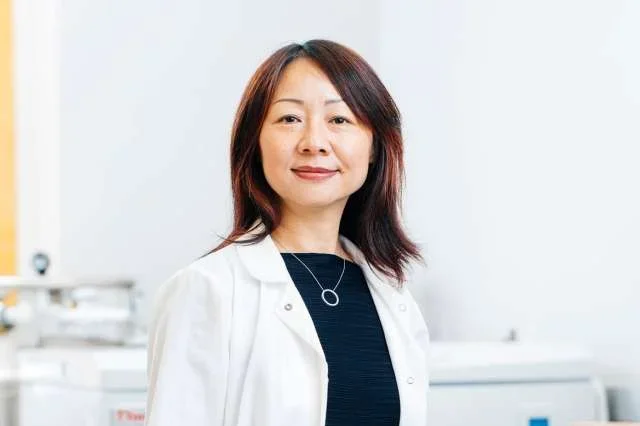
A Legacy of Discovery - Then and Now
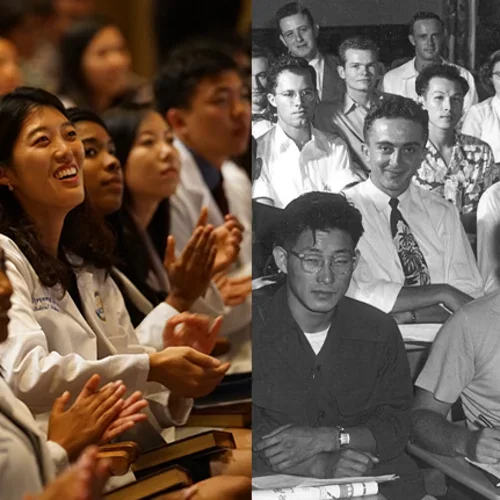
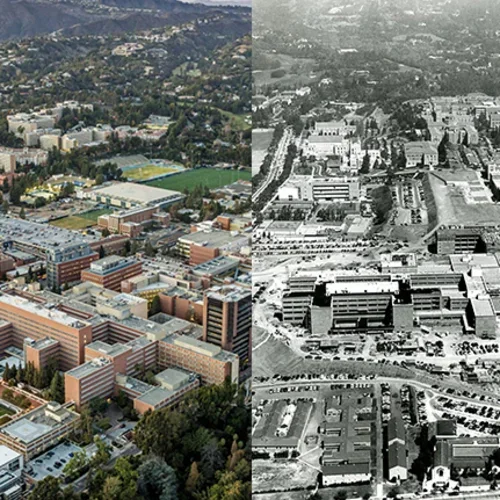
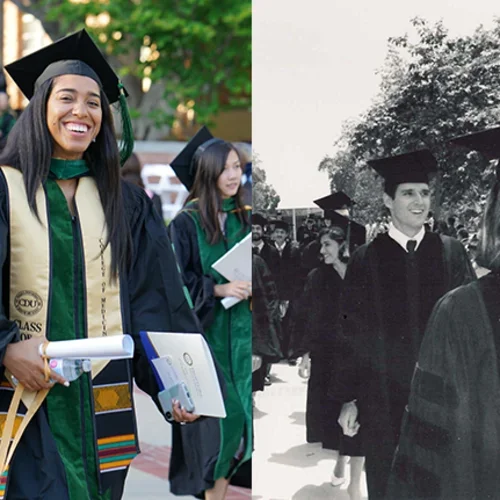
Defining Moments
1947: First Dean
Stafford L. Warren, M.D., was appointed the first dean of the medical school. A former colonel in the United States Army Medical Corps and chief of the Manhattan Project’s medical section and a radiologist by training, Dr. Warren is credited with the discovery of a breast imaging technique that led to the invention of the mammogram.
1950s: First Willed-Body Program
UCLA establishes the first willed-body program in the world, allowing people to leave their bodies to science upon dying for research purposes.
1951: Doors Open
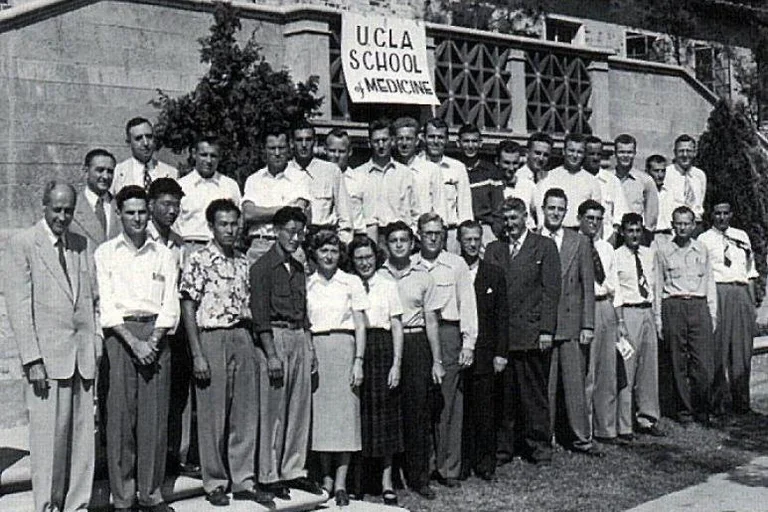
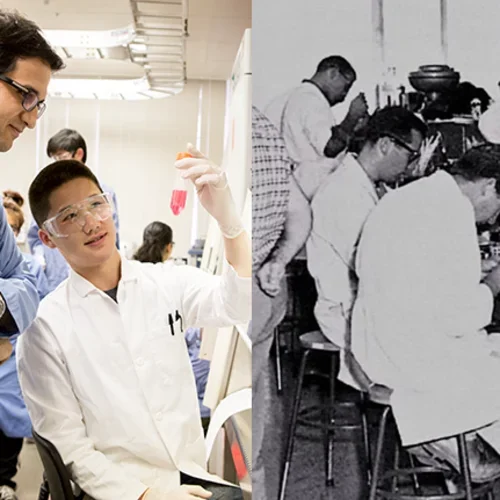
Classes begin on Sept. 20 for the medical school’s first students—two women and 26 men—taught by 15 faculty members. Four-year attendance cost $10,000. Since it took several years to build the new school, scientists conducted research in wartime Quonset huts scattered across campus.
1953: LGBTQ Rights
Psychology professor and research associate Evelyn Hooker, Ph.D., conducts groundbreaking research debunking the belief that homosexuality is a mental illness.
1955: Medical Facility of the Atomic Age
UCLA Medical Center opens to patients and is heralded as the first hospital of the Atomic Age, marking the first use of the atomic smasher for medical purposes.
1961-1963: Computerized Tomography
William Oldendorf, M.D., establishes the bedrock for non-invasive imaging technologies: computer-assisted tomography (CAT) scan and magnetic resonance imaging (MRI).
1964: Tissue Matching
Paul Terasaki ’50, M.S. ’52, Ph.D. ’56, who spent three years with his family in a Japanese-American internment camp before becoming a three-time UCLA graduate, develops the tissue-matching test that makes organ transplants possible. The test is now the international standard for tissue typing.
1971: Art and Medicine
Artist May Lesser, M.F.A., embedded with the Class of 1971, completes her four-year medical journey and later publishes The Art of Learning Medicine based on her experience. The book uses her impressive body of artwork (including drawings and color etchings) as well as her commentary to chronicle the human side of medical education.
1975: Leading the Way
Gail Wyatt, Ph.D. ’73, becomes the first Black woman licensed as a psychologist in the state of California. She is the first Black female full professor in the UCLA School of Medicine and the first person of color to receive a coveted K (or Research Scientist Career Development) Award from the NIH.
Related UCLA Health News & Insights Article(s):
"With several 'firsts,' Dr. Gail Wyatt lays the groundwork for women of color"
1978: Molecular Imaging
Michael Phelps, Ph.D., and Edward Hoffman, Ph.D., create UCLA’s first clinical positron emission tomography (PET) center.
1978: Connecting Westwood to South LA
The Charles R. Drew University of Medicine and Science in south Los Angeles and the UCLA School of Medicine establish the Charles R. Drew/UCLA Medical Education Program to train health care leaders who will advance humanistic health in underserved communities.
1978: Community Partnership
UCLA forms a formal affiliation with Venice Family Clinic, which will become the nation’s largest free medical clinic. Today, with the help of UCLA medical faculty, resident and students, the clinic serves more than 27,000 low-income and homeless LA residents annually.
1980: Trailblazer in Surgery
Marjorie Fine, M.D. ’75, R.E.S. ’80, becomes the first woman to complete the general surgery residency at UCLA. Dr. Fine went on to become one of the first female surgeons at Saint John’s Hospital and Health Center. During the past decade, she has worked overseas in third-world countries, leading and participating in surgical missionary work.
1981: AIDS Research
UCLA physicians report and describe the first cases of AIDS, a discovery that will lead to the formation of the UCLA AIDS Institute and the school’s standing as a world leader in AIDS research.
Related UCLA Health News & Insights Article(s):
1983: Launch of Physician-Scientist Track
Funded by the NIH, the UCLA Medical Scientist Training Program opens its doors to those pursuing a joint M.D.-Ph.D. degree. In 1997, the program formed an affiliation with Caltech to expand opportunities for innovative research and training further.
1983: Landmark Leukemia Drug
Owen Witte, M.D., pinpoints a genetic target crucial to the development of life-saving drugs.
1984: New Heights
Anna Lee Fisher ’71, M.D. ’76, M.S.’87, a chemist, physician, and NASA astronaut, becomes the first mother in space when she embarks on mission STS-51A aboard the space shuttle Discovery.
1984: Pioneers in Heart Transplantation
Hillel Laks, M.D., the first U.S. cardiac surgeon to perform bypass surgery on a donor heart prior to transplantation, founds the UCLA Heart Transplant Program.
1984: First on the West Coast
Helmed by Ronald Busuttil, M.D., Ph.D., UCLA opens the first liver transplant program west of the Mississippi. One of the first such programs in the nation, it is now one of the world’s largest transplantation programs.
1988: Genetic Basis of Disease
Michael Grunstein, Ph.D., demonstrates that histones influence gene expression and disease development.
Related UCLA Health News & Insights Article(s):
1988: New Visions
Patricia Bath, M.D., invents Laserphaco, a device and technique that begins the laser era of cataract surgery. She is the first Black woman to receive a medical patent, the first woman to serve on the UCLA Stein Eye Institute faculty, the first Black female surgical faculty at UCLA, and the first female chair of an ophthalmology residency program at a U.S. medical institution.
Related UCLA Health News & Insights Article(s):
1990: Student-led Street Medicine
Students join the Department of Family Medicine at UCLA to create the Student Run Homeless Clinic, which provides free medical care and services to the unhoused at pop-up sites across Los Angeles.
1990: Brain Aneurysm Treatment
Guido Guglielmi, M.D., invents detachable coils that stop deadly bleeding from brain aneurysms.
1992: Innovations in Teaching
UCLA School of Medicine launches “Doctoring” curriculum, which takes a new, patient-centered approach to medical education. Students are introduced to a wide variety of communication skills and psychosocial factors (including substance abuse, domestic violence, and mental health) that play an important role in patient encounters. The program serves as a model for dozens of other medical schools in the U.S. and around the world.
1993: Revolutionizing Residency Training
UCLA launches the Specialty Training and Advanced Research (STAR) Program, allowing residents and fellows to pursue a Ph.D. at UCLA, Caltech, or the RAND Corporation simultaneously with their clinical specialty training.
Related UCLA Health News & Insights Article(s):
1994: Metabolic Genetic Origin
Elizabeth Neufeld, Ph.D., receives the National Medal of Science for research critical to treating metabolic disorders.
1998: Precision Cancer Treatment
Dennis Slamon, M.D., Ph.D., identifies the HER2/neu oncogene, which leads to the development of the breast cancer drug trastuzumab (Herceptin), that has saved millions of women’s lives by targeting a specific genetic alteration.
Related UCLA Health News & Insights Article(s):
1998: Molecular Signaling
Louis Ignarro, Ph.D., receives the Nobel Prize in Physiology or Medicine for demonstrating the signaling properties of nitric oxide.
2002: A Transformational Gift
Entertainment executive and philanthropist David Geffen donates $200 million, the largest single gift to a school of medicine in U.S. history, to the medical school, which is renamed in his honor. The unrestricted gift helps propel the school to its current status as a world-class institution for education and research.
2004-2010: Prostate Cancer Treatment
Charles Sawyer, M.D., and Michael Jung, Ph.D., develop a drug to fight castration-resistant prostate cancer.
Related UCLA Health News & Insights Article(s):
- "FDA approvals put UCLA Health Jonsson Comprehensive Cancer Center at leading edge of game-changing treatments"
- "How Michael Jung’s team created a drug to extend the lives of men with prostate cancer"
- "UCLA researcher receives AACR honor for prostate cancer discovery"
- "Astellas, Medivation to develop, commercialize MDV3100 for treatment of prostate cancer"
- "New drug shows promise in treating drug-resistant prostate cancer"
2008: Championing Future Healthcare Leaders
UCLA joins Programs in Medical Education (PRIME), a UC-wide initiative, and launches a five-year program to earn an M.D. and a master’s degree. PRIME develops leaders in medicine addressing policy, care, and research in health care for the underserved.
2008: The Future of Medicine, Now Open
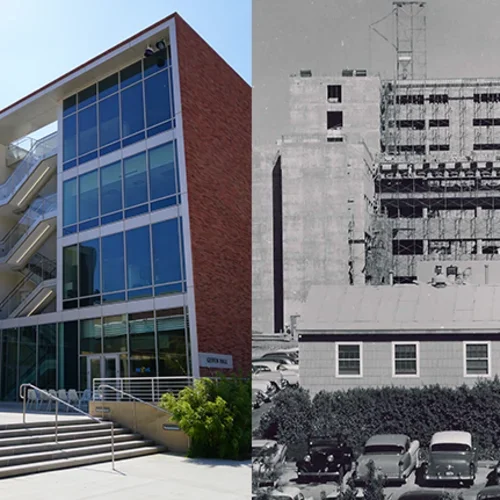
Ronald Reagan UCLA Medical Center, designed by I.M. Pei, opens its doors on June 29, replacing the 1950s Center for Health Sciences (CHS) that was structurally weakened by the 1994 Northridge earthquake.
2010: Academic Leadership
A. Eugene Washington, M.D., M.P.H., M.Sc., an internationally-renowned clinical investigator and health policy scholar, becomes the first Black dean of the David Geffen School of Medicine at UCLA.
2012: Game-Changing Scholarship
David Geffen gives $100 million to establish the David Geffen Medical Scholarships, enabling approximately 25% of medical students to graduate debt-free.
Related UCLA Health News & Insights Article(s):
2015: Successful Gene Therapy
Donald B. Kohn, M.D., cures “Bubble Baby” disease using gene therapy.
Related UCLA Health News & Insights Article(s):
2016: First Woman Dean
Kelsey C. Martin, M.D., Ph.D., becomes the first female dean of the medical school. A neuroscientist who was inspired to pursue medicine by her experience as a Peace Corps volunteer, Dr. Martin is a leader in driving cross-disciplinary activities that bridge clinical medicine with academic scholarship in the basic sciences, social sciences, data sciences, and engineering.
Related UCLA Health News & Insights Article(s):
2018: South Tower Move
Thirty-three laboratories and hundreds of biomedical researchers move from historically siloed units into a new, shared space in the CHS South Tower. The medical school’s compact, walkable campus instills a collaborative culture across research labs, the hospital, clinics, and schools of nursing, engineering, and dentistry.
Related UCLA Health News & Insights Article(s):
2019: Fighting Brain Tumors
Linda Liau, M.D., Ph.D. ’99, M.B.A., world-renowned brain surgeon and cancer researcher who is pioneering the use of a dendritic cell-based vaccine for glioblastoma, is elected chair of the American Board of Neurological Surgery. She is the first woman to chair the organization in its 80-year history and the first woman to chair the UCLA Department of Neurosurgery.
Related UCLA Health News & Insights Article(s):
2019: Upping A Game Changing Scholarship
David Geffen gives an additional $46 million to the David Geffen Medical Scholarships fund, opening the doors for 120 additional students to benefit.
Related UCLA Newsroom Article:
2020: Meeting the Moment
Students assist at COVID-19 testing sites and form the LA COVID Volunteers, a group of 700+ UCLA scholars who provide free child care, grocery runs, and PPE to essential workers and their families during the pandemic. They deliver more than 50,000 face shields to UCLA Health and community partners in need.
2023: Enhancing Technology in Education & Training
Made possible by a $20 million gift from donors Eugene and Maxine Rosenfeld, DGSOM opens Rosenfeld Hall - the new home for the UCLA Simulation Center and the UCLA Health Center for Advanced Surgical & Interventional Technology (CASIT). The 30,000-square-foot hub for all four health sciences professional schools features new training technologies and equipment such as laparoscopic and robotic surgery simulators, fully immersive virtual reality, computerized manikin patients and birthing simulators, among other features.
2023: Expanding Our Research Footprint
UCLA closes out 2023 by acquiring L.A.’s former Westside Pavilion, a 700,000-square-foot property located just 2 miles south of the Westwood campus, with the intent to house the California Institute for Immunology and Immunotherapy (CIII) at UCLA and the UCLA Center for Quantum Science and Engineering, as well as programs across the disciplines. The acquisition is made possible by an intended $500 million investment from the state of California.
Related UCLA Health News & Insights Article(s):
2023: Building the "Research Equivalent of Silicon Valley"
The California Institute for Immunology and Immunotherapy (CIII) at UCLA is established to bring together scientists and industry partners to streamline the process from scientific discovery to tangible treatments for patients. CIII aims to make UCLA, what UCLA Health CEO John Mazziotta, MD, PhD calls, “the research equivalent of Silicon Valley” and Los Angeles the center of scientific innovation and industry
Related UCLA Health News & Insights Article(s):
2025: First Human Bladder Transplant
A historic surgery, the result of years of research, the first human bladder transplant performed at UCLA. The surgery was successfully completed at Ronald Reagan UCLA Medical Center on May 4, 2025. The team was led by Dr. Nima Nassiri, a urologic transplant surgeon and director of the UCLA Vascularized Composite Bladder Allograft Transplant Program, with assistance from Dr. Inderbir Gill, founding executive director of USC Urology.
Related UCLA Health News & Insights Article(s):
2026: Expanding Cell and Gene Therapies
UCLA opens Center for Advanced Biotherapies, expanding capacity to develop and deliver cell and gene therapies with a new 14,000 square-foot manufacturing facility built from the ground up inside the UCLA's Center for Health Sciences.