Preparing future physicians for the world of healthcare AI
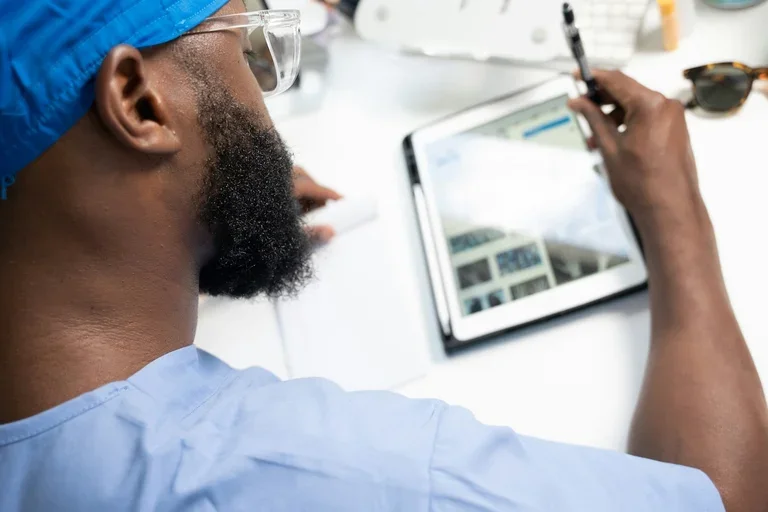
Academic medical centers nationwide are exploring the intersection of AI and education, considering how rapidly developing tools might fit into the education of future physicians.
Associate Dean for Health AI Strategy and Innovation Katherine Andriole, PhD, is one of the leaders guiding the David Geffen School of Medicine (DGSOM) at UCLA as the medical school evaluates how to best prepare students to thrive in the age of AI.
“I consider the conversation about education and AI to have two parts,” Andriole said. “The first is about AI literacy. Medical students and trainees, as well as faculty and staff, need a foundational understanding of how these tools work. The second is about how we can use AI tools to enhance and enable education.”
AI literacy: A crucial cornerstone
Andriole’s vision is proactive and realistic. In today’s healthcare landscape, it is unlikely that physicians and researchers won’t encounter studies, applications and other diagnostic support tools that use AI. That’s why Andriole is passionate about preparing every DGSOM graduate to understand, evaluate and pose questions about AI in medicine.
“Understanding at a high level how these tools work allows those trained in medicine to understand AI’s limitations and utilize it safely and effectively,” she said. “What questions should you ask? How can AI models fail? What is a plausible but incorrect result? All of that is part of AI literacy.”
One might wonder how a foundational understanding of such dynamic technology could be possible; however, the fundamentals of artificial intelligence have remained largely unchanged for 50 years. Just as all incoming students have learned anatomy, physiology, pathology, statistics, etc. the basics of AI are important to study too.
“It's a bit like driving a car. I don't necessarily know exactly how the car works, but I know the car requires gas to run, I know where the gas goes, where the lights are and how to operate it. If I rent a different car, I can generally figure it out because I understand the fundamentals. If I don't understand the fundamentals of something I am using, I'm in trouble. That's where I think we need to be with health AI.”
There are risks if AI remains a mystery. Andriole shared an example of a paper posted on arXiv, a popular non-peer-reviewed repository, that used data from electronic medical records to determine which patients were most likely to get cancer.
“It was a great question,” Andriole said, “but the model indicated that the most important factor associated with getting cancer was being male. A bold result, but certainly not the right answer to the study’s question. Why? Because, as it turns out, the model was biased. The AI was trained using patient data from a Veterans Affairs hospital, which treated mostly male patients who were of an age where cancer becomes more common. That's why we need to understand how these tools work. Without understanding that the patient cohort was improperly constructed, someone may have taken that model’s result at face value.”
Using AI to enhance and enable education
Complementing the need for AI literacy is the hands-on use of AI alongside clinical experience and class-based learning.
“It's very important to teach AI fundamentals using healthcare use cases,” Andriole said. “You can go online and find a million AI courses, but I think health AI is best taught and best retained using clinical use cases. That’s what we aim to do here.”
Together with Andriole, groups including the UCLA Health AI Council and the UCLA AI in Medical Education Council are carefully evaluating how to create sustainable clinical and classroom-based learning opportunities.
“The UCLA AI in Medical Education Council has done tremendous work. Chaired by Dr. Serena Weng, the committee has been putting together curricular frameworks, covering issues ranging from chatbots to ethics, considering bias in modeling, and whether emerging tools can meet the needs of all patients."
Inspired and guided by these intentional conversations, professors are already using AI in DGSOM classrooms to elevate students’ learning to a new level.
Through the UCLA Simulation Center, digitally created patients are helping students learn patient interviewing and communication skills in realistic scenarios. Clinically, radiology trainees are using tools that automatically note findings on imaging.
In both cases, Andriole shares an important reminder.
“Reviewing medical knowledge with AI or utilizing tools that detect certain results requires human critical thinking. Even though that tool exists, we want our residents to learn how to detect these findings on their own.”
At DGSOM, Andriole emphasizes that students will continue to learn those irreplaceable skills. “I see countless examples of our students learning how to assimilate their thoughts about what might be going on with their patients and develop differential diagnoses without the use of AI. There is no replacement for a doctor deciding whether certain labs should be run, and what their course of clinical management should be.”
An evolving path forward
Although health AI will undoubtedly evolve, what students learn at DGSOM will prepare them for what’s ahead. In turn, Andriole expects that our students’ progressive digital expertise will end up teaching their professors and school leadership as well.
“Already, many of our students have backgrounds in artificial intelligence and related technologies from their undergraduate education and may be quite advanced in some of these areas,” she shared.
“One day, some may work with industry partners or researchers to develop clinically relevant tools that solve problems they encounter on the front lines of patient care. Others may use these technologies in research and discovery.”
What matters most is that all DGSOM graduates will leave with an understanding of how AI may impact their work, regardless of the level at which they choose to engage.
“At UCLA, we want to educate and develop the next leaders in healthcare, and that includes the next generation of leaders in health AI,” she said. “Our hope is that their future success will start with the fundamentals they’ve learned here.”
Related Articles