Three medical students earn prestigious research fellowships
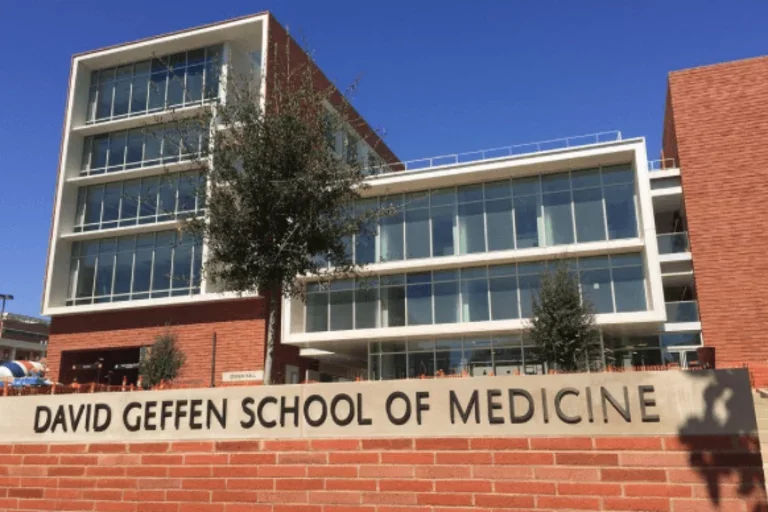
With different specialties, backgrounds and goals, three David Geffen School of Medicine at UCLA students now have one thing in common: the honor of receiving a highly competitive fellowship. Each opportunity unlocks new worlds of mentorship and education.
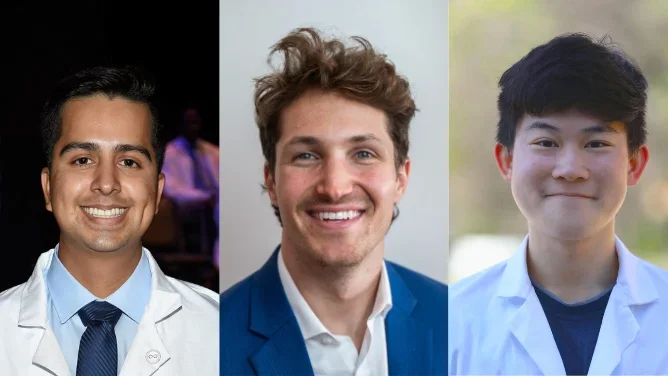
Daniel Chen received the Paul & Daisy Soros Fellowship, while Juan Melesio and Samual Margolis were both named to the Sarnoff Fellowship Program. Both awards are notable for their future-forward influence and long-lasting mentorship, as well as for their selectivity.
Breaking Through a Field of Thousands
The Soros Fellowship, awarded to 30 students annually who are either immigrants themselves or children of immigrants and are pursuing graduate school in the United States, received more than 3,000 applicants for the 2026 class. Each recipient will receive up to $90,000 in funding over two years.
“It is an honor to receive the Paul & Daisy Soros Fellowship,” Daniel said. “My family has always encouraged me to seize upon what made me curious. Their support, as well as the scholarships and mentorships like the Soros Fellowship, empowers me to fully devote myself to my research. I could not be more grateful for this opportunity.”
Likewise, the Sarnoff Fellowship Program, which is sponsored by the Sarnoff Cardiovascular Research Foundation, has an acceptance rate of around 10-15%. Fellows spend one year conducting intensive research at a laboratory anywhere in the country under the guidance of an advisor, culminating in a manuscript for peer-reviewed publication.
Juan, expressing his gratitude, said, “I’m deeply inspired by the Sarnoff community. Seeing world-class leaders return to the Foundation year after year to mentor the next generation of scholars shows a level of commitment that I can’t wait to be a part of.”
Focusing on the Research Journey Ahead
Daniel, Juan and Sam aim to use their fellowship years to answer challenging questions in medical research. Along the way, they will receive outstanding mentorship while connecting with peers and leaders across many disciplines and areas of expertise.
Sam shared, “Uninterrupted funded time to think and build is rare in medicine. I’m excited to get to work alongside some of the smartest people at the edge of their fields in cardiology, engineering and biology.”
Daniel is already working on research with two of his UCLA professors, Antoni Ribas, MD, and Katie Cambell, MD, and is excited to continue. “The research I’m working on focuses on how immune checkpoint blockade, called ICB, may overcome initial resistance to cancer therapy. ICB is a type of immunotherapy that seeks to release the brakes on a patient’s immune system so it can function more effectively. We’re working on how to break through acquired resistance to ICB that prevents complete remission.”
Juan and Sam, both studying cardiovascular medicine, have their own research goals.
For Juan, the potential for future scalability motivates him most.
“I want to unlock the potential cardiac applications of induced pluripotent stem cells (iPSCs) with a particular emphasis on better understanding cardiac fibrosis. The goal is to use iPSCs to model how scarring occurs and then identifying drug targets capable of inhibiting those pathways. The mechanisms of fibrosis are nearly universal. If we can find a way to stop this process, the impact could reach beyond cardiovascular health and into scarring that affects almost every organ system in the body.”
Also focused on cardiology, Sam hopes to play a research-driven game of matchmaker.
“I want to connect clinical medicine and machine learning, using large-scale patient data and AI models to find disease subtypes and phenotypes we’ve been lumping together for too long; then, tracing those patterns back to their genomic basis and potential treatments,” he shared.
All three students are eager to get started. While the path ahead may be new and unfamiliar, Daniel, Juan and Sam all agree it will certainly be transformative.
Related Articles